9 Top Alternatives to Mighty Networks
The digital landscape has shifted beneath our feet without us quite noticing the moment the ground moved.
For years we were content to build our homes on rented land while entrusting our communities to the algorithmic whims of massive social networks that viewed our members merely as data points.
There is a growing realisation among creators and community leaders that true connection requires a sanctuary away from the noise of the infinite scroll.
We are witnessing a migration from the open and chaotic town squares of the internet into private and purposeful digital gardens where depth matters more than reach.
This movement is driven by a desire for ownership and not just of the content we produce but of the relationships we nurture.
As Seth Godin once observed about the power of tribes a group of people connected to one another and connected to a leader and connected to an idea is an unstoppable force.
The tools we use to facilitate these connections are no longer just utilities because they are the architecture of our digital culture.
Mighty Networks has long been a formidable player in this space by offering a robust suite of features that blend courses with community.
However the specific needs of a community are as unique as the individuals who comprise it and what works for one group may feel restrictive to another.
Some leaders require the pixel perfect control of a dedicated website while others need the raw power of a learning management system.
Choosing the right platform is akin to choosing the right building for a physical gathering because the acoustics and the lighting and the layout all influence the conversation.
The following list explores nine sophisticated alternatives that offer different philosophies on how to bring people together online.
Each platform carries its own ethos and its own strengths and its own distinct way of fostering human connection in a digital age.
We will look beyond the feature lists to understand the soul of these platforms and who they are truly built to serve.
It is worth remembering that the technology is merely the vessel while the magic lies in the people you pour into it.
Let us explore the landscape of digital community platforms with a critical but appreciative eye.
Odd Circles ($6/month)
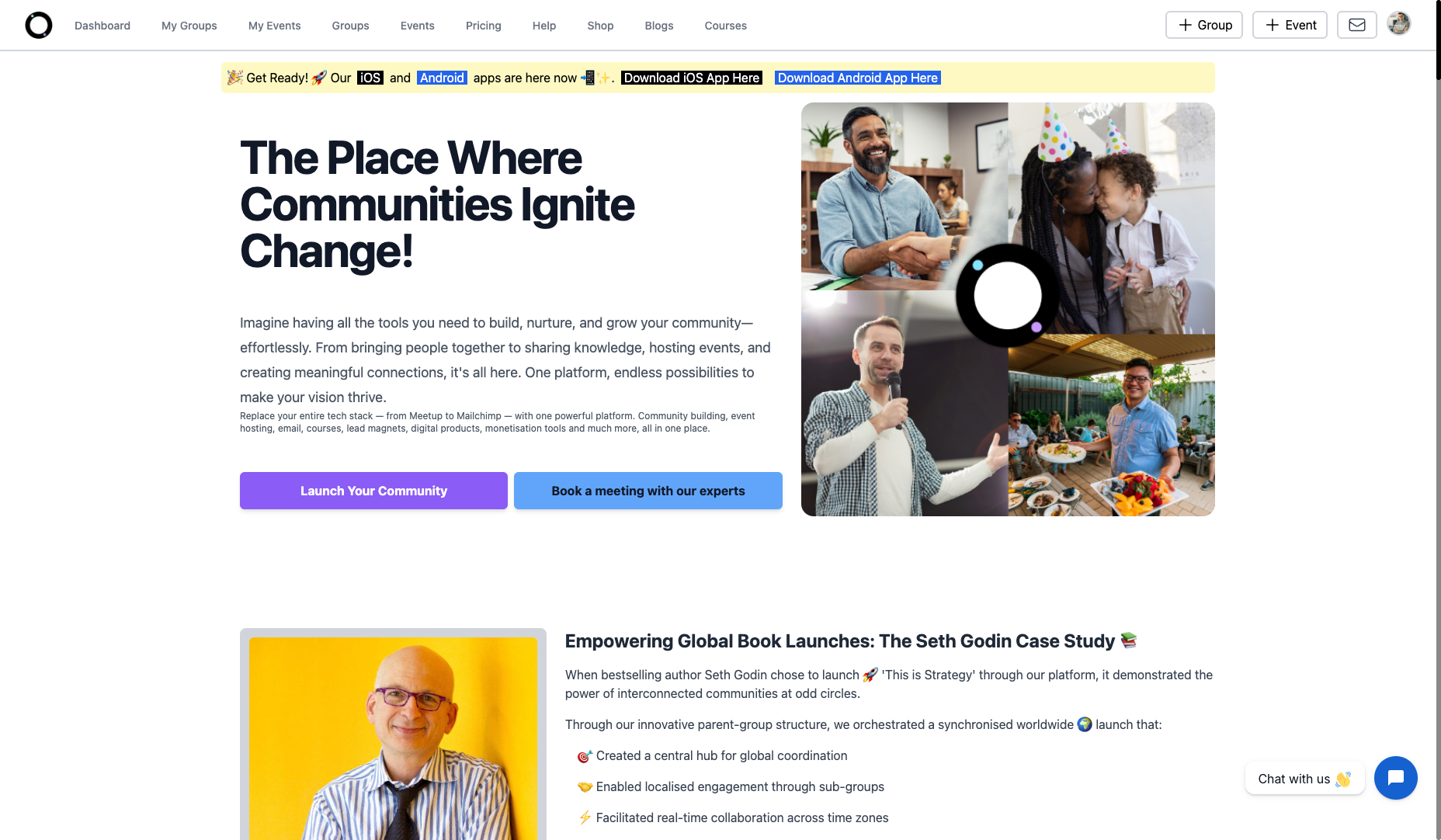
There is a refreshing clarity to Odd Circles that sets it apart immediately from the dense feature sets of its competitors.
While many platforms try to be everything to everyone Odd Circles focuses intensely on the event driven nature of real community.
It is designed for leaders who understand that shared experiences are the glue that holds a group together.
The platform removes the financial barrier to entry that stops so many great communities from ever launching.
Hosts can create groups and manage members and list events without facing the daunting monthly subscriptions common in this industry.
Revenue is generated through a small fee added to ticket sales meaning the platform only succeeds when your community thrives.
This alignment of incentives creates a partnership dynamic rather than a landlord and tenant relationship.
The interface is clean and intuitive while stripping away the administrative clutter that often burns out community managers.
It handles the complexities of ticketing and member management and communication with a quiet efficiency.
For those who view their community as a series of meaningful gatherings rather than a content repository this is a natural home.
It feels like a tool built by people who have actually run communities rather than just engineered software for them.
This approach brings back the organic feel of meeting up which is often lost in the rush to monetise every interaction.
The focus here is on the human element where the software gets out of the way to let the connections happen.
It is particularly powerful for local groups or interest based clubs that meet regularly and need a reliable way to organise.
The absence of a monthly fee allows smaller groups to experiment and grow without the pressure of overhead costs.
Odd Circles reminds us that community is often about doing things together rather than just talking about things.
Circle (Starts at $89/month)
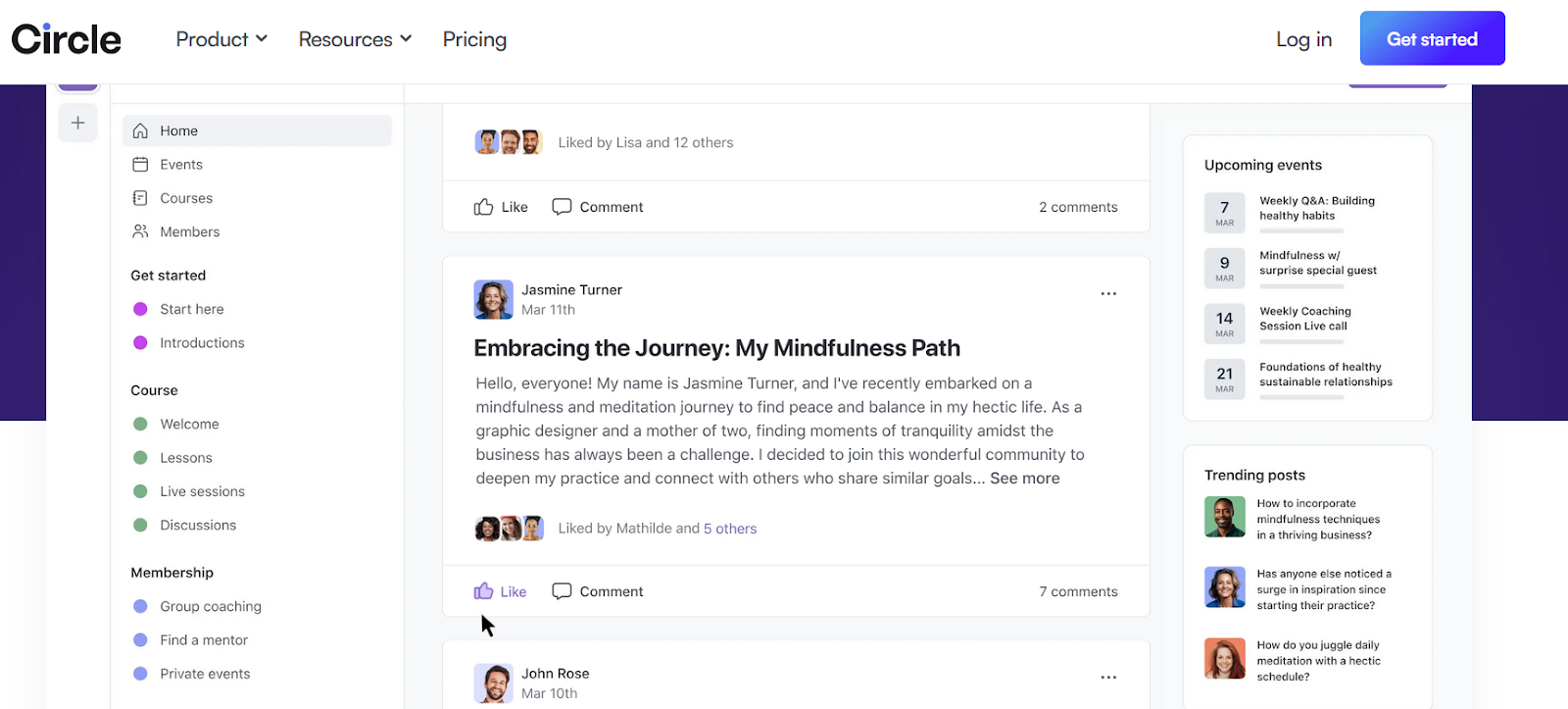
There is a particular elegance to Circle that has captured the imagination of the modern creator economy.
It feels less like a piece of legacy software and more like a modern living room designed for thoughtful conversation.
The platform was born out of a frustration with the fragmented nature of online groups where discussions were often lost in a sea of distractions.
Circle places the content and the conversation on equal footing by removing the clutter that often plagues more complex systems.
It allows you to weave together a narrative that includes live video and static posts and rich media without overwhelming the user.
Many creators appreciate the visual customisation which allows the space to feel like a natural extension of their personal brand rather than a third party outpost.
The user experience is intuitive borrowing the best interaction patterns from popular social apps while stripping away their addictive and toxic elements.
It is a favourite among those who value design and user experience as much as functionality.
The integration capabilities are vast allowing it to sit comfortably in the middle of a complex tech stack while connecting with email providers and payment gateways seamlessly.
However its simplicity is a deliberate choice and those seeking complex and multi layered permissions might find it initially too streamlined.
Circle has successfully managed to make community management feel less like an administrative burden and more like a creative pursuit.
The team behind it seems to understand that a community manager is not just a moderator but a host.
It fosters a sense of intimacy that is hard to replicate on platforms designed for mass broadcasting.
This platform is ideal for creators who want to offer a premium experience to their most loyal followers.
The clean lines and thoughtful whitespace create an environment where high quality discussion can flourish.
Kajabi (Starts at $55/month)
If Circle is the elegant living room then Kajabi is the sprawling and high tech campus.
It is a powerhouse designed not just for community but for the entire lifecycle of a digital knowledge business.
Kajabi operates on the philosophy that you should not have to tape together five different tools to run your empire.
It integrates email marketing and landing pages and payment processing and course delivery into a single and cohesive engine.
For the entrepreneur who wants to minimise technical headaches Kajabi offers a reassuringly solid solution.
The community features in Kajabi were once an afterthought but have recently been overhauled to become a central pillar of the suite.
They have recognised that knowledge retention increases significantly when students can discuss the material amongst themselves.
The platform excels at high ticket sales by providing sophisticated funnels that can guide a stranger to becoming a loyal member with automated precision.
Critics often point to the price tag which is higher than most but proponents argue that it replaces the cost of several other software subscriptions.
There is a confidence in using Kajabi because it feels like driving a luxury car where every button is exactly where you expect it to be.
It is particularly well suited for coaches and consultants who are serious about monetising their expertise at scale.
The platform does not shy away from the commercial aspect of community because it embraces it.
It provides the analytics and data necessary to treat your community not just as a social gathering but as a business asset.
Kevin Kelly’s concept of "1,000 True Fans" finds a practical home here where the tools exist to serve those fans deeply and sustainably.
This integration means you never have to worry about a plugin breaking or an update crashing your site.
BuddyBoss (Starts at approx. $228/year)
For those who believe that the open web is the only true home for content BuddyBoss offers a compelling argument.
It is not a standalone platform in the traditional sense but rather a powerful layer that sits on top of WordPress.
This distinction is crucial because it means you truly own your data and your code and your destiny.
BuddyBoss allows you to build a social network that rivals the giants in terms of functionality all within your own hosting environment.
It appeals to the tinkerer and the developer and the organisation that cannot afford to have their community shut down by a third party decision.
The flexibility is infinite because if you can dream it and you have the technical resource you can build it.
It transforms a standard website into a bustling hub with activity feeds and private messaging and member profiles.
However this power comes with a responsibility to manage the technical aspects of hosting and maintenance.
It is not a set it and forget it solution but rather a foundation for a custom built digital structure.
Many universities and large non profits gravitate towards BuddyBoss because it integrates so deeply with learning management systems like LearnDash.
The philosophy here is one of sovereignty because you are not renting space you are building on your own land.
It represents the maturity of the open source movement by proving that free software can look and feel as premium as any proprietary tool.
There is a steep learning curve but the reward is a platform that fits your organisation like a tailored suit.
This is the choice for those who want total control over every pixel and every interaction.
Disciple (Starts at $46/month)
In a world where the smartphone is the primary window to the internet Disciple takes a mobile first approach that is hard to ignore.
They understand that push notifications are the new email open rates.
Disciple specialises in creating white label mobile apps that sit on your members home screens right next to Instagram and WhatsApp.
There is a significant psychological shift that happens when a member sees your logo on their phone every day.
It moves your community from being a destination they have to remember to visit to a constant presence in their pocket.
The interface is slick and familiar while mimicking the best parts of social media feeds without the algorithmic interference.
Musicians and fitness instructors and lifestyle brands often find their home here because the content consumption is quick and visual and on the go.
It allows for a direct line of communication that feels personal and immediate.
The barrier to entry for having your own app was once incredibly high costing tens of thousands of pounds in development.
Disciple has democratised this access by allowing smaller creators to have a professional mobile presence.
While they offer a web version the heart of the experience is undeniably on the small screen.
It is a platform for leaders who want to be a part of their members daily rituals.
The focus is on engagement metrics that matter such as tracking how often people return and how deeply they interact.
This creates a high frequency loop of interaction that is perfect for habit forming communities.
Hivebrite (Starts at $799/month)
When the scale of a community reaches the thousands or tens of thousands the requirements shift from intimacy to organisation.
Hivebrite is built for these large scale and often institutional networks.
It is the platform of choice for alumni networks and professional associations and corporate incubators.
The feature set is extensive offering complex directories and job boards and event management tools that smaller platforms lack.
It understands that in a large community the value often lies in member to member networking rather than just consuming content.
The search capabilities allow members to find each other based on skills or location or industry thus fostering connections that happen without the community manager intervention.
It is a robust and serious tool for serious organisations.
There is less focus on the creator economy aesthetic and more on professional utility and data management.
Hivebrite allows for a granular control over permissions meaning different sub groups can exist within the larger ecosystem without cross pollination if desired.
It solves the problem of how to make a massive group of people feel manageable and connected.
The platform acts as a digital rolodex that has come to life by facilitating mentorships and professional opportunities.
For an organisation looking to mobilise a global network Hivebrite offers the necessary infrastructure to handle the weight.
It is designed for longevity and stability making it a safe bet for institutions with long term horizons.
Podia (Starts at $33/month)
There is a segment of the market that craves simplicity above all else and Podia serves this group with a delightful minimalism.
It rejects the idea that powerful software must be complicated.
Podia started as a way to sell digital downloads and has evolved into a full fledged community and course platform.
It is designed for the solo creator who wants to spend their time creating not configuring settings.
The interface is clean and friendly and remarkably easy to navigate for both the admin and the member.
It eliminates the tech paralysis that stops many great projects from ever launching.
While it may lack the deep customisation of a BuddyBoss or the complex funnels of a Kajabi it makes up for it in speed and ease of use.
Podia allows you to sell a membership and a course and a digital download from the same checkout cart which is a feat that is surprisingly rare.
The community interface is linear and straightforward encouraging discussion without the pressure of a complex social feed.
It feels like a boutique shop rather than a department store.
Their customer support is legendary in the industry for being human and responsive and genuinely helpful.
It is the perfect starting point for someone who wants to validate their idea without a heavy upfront investment of time or money.
The all in one nature of Podia means you can launch a business in an afternoon.
Thinkific (Starts at $36/month)
Education is the bedrock of many communities and Thinkific has staked its claim as the premier platform for serious course creators.
While many platforms offer courses as a feature Thinkific treats education as the core mission.
It provides a level of pedagogical structure that is appreciated by instructional designers and professional educators.
The platform allows for complex quizzes and prerequisites and certification ensuring that the learning journey is rigorous.
Recently they have expanded their community features to support the learning experience recognising that peer support is vital for student success.
It is widely used by universities and training organisations that need a reliable and scalable system to deliver curriculum.
The separation between the learning environment and the community space is handled thoughtfully allowing students to focus when they need to and connect when they want to.
Thinkific offers a high degree of brand control allowing the course player to look professional and bespoke.
It integrates well with other tools accepting that it is part of a larger ecosystem of business software.
For those whose primary product is transformation through education Thinkific offers the most robust set of tools to ensure that transformation happens.
It is less about the cult of personality and more about the efficacy of the material.
The data reporting on student progress is granular helping instructors identify where students are getting stuck.
Discourse (Starts at $20/month for hosted)
If you strip away the courses and the sales funnels and the marketing automation what you are left with is pure conversation.
Discourse is the undisputed king of the modern forum.
It was built by Jeff Atwood one of the founders of Stack Overflow who understands deeply how people talk on the internet.
It reimagines the dusty old forums of the 1990s as modern and dynamic and real time streams of thought.
The philosophy behind Discourse is that civilized discourse requires software that encourages good behaviour.
It has built in gamification and trust levels that automatically grant more privileges to members as they contribute positively.
This creates a self policing immunity system that keeps toxicity at bay without constant manual moderation.
It is open source and incredibly powerful used by tech giants and small hobbyist groups alike.
Discourse is for communities where the primary value is the archive of knowledge generated by the members.
It is not designed for selling courses or hosting landing pages because it does one thing and does it perfectly.
The search functionality is lightning fast making the community a living library of answers.
For technical communities and gamer groups or interest based clubs where discussion is the product Discourse is the gold standard.
It encourages long form reading and thoughtful replies rather than quick and ephemeral reactions.
The importance of choosing the right platform cannot be overstated.
In their research on online communities social scientists have found that the architecture of a digital space significantly shapes the behaviour of its inhabitants.
Just as a cathedral inspires awe and a coffee shop encourages chatter these platforms subtly direct the energy of your group.
When we build these spaces we are doing more than installing software because we are defining the rules of engagement for a group of human beings.
As we move further into this decade the most successful communities will be those that respect the time and attention of their members.
The era of the general purpose social network is waning giving way to these purpose built environments.
Whether you choose the sleek modernity of Circle or the accessible events of Odd Circles or the educational rigour of Thinkific the goal remains the same.
To create a space where people can feel seen and heard and valued.
That is a timeless human need and the technology is finally catching up to help us fulfil it.
Curated Platform Directory
Odd Circles · www.oddcircles.com
Mighty Networks · www.mightynetworks.com
Mighty Pro · www.mightynetworks.com/pro
Circle · circle.so
Nas.io · nas.io
Memberful · memberful.com
Kajabi · kajabi.com
Podia · www.podia.com
Thinkific · www.thinkific.com
Teachable · teachable.com
Uscreen · www.uscreen.tv
Patreon · www.patreon.com
Substack · substack.com
Discord · discord.com
Discourse · www.discourse.org
Disciple · www.disciplemedia.com
Hivebrite · hivebrite.io
Bettermode · bettermode.com
Higher Logic Vanilla · www.higherlogic.com/vanilla
Geneva · www.geneva.com
Wild Apricot · www.wildapricot.com
BuddyBoss · www.buddyboss.com
MemberPress · memberpress.com
MemberSpace · www.memberspace.com
Kartra · www.kartra.com
ClickFunnels · www.clickfunnels.com
Bold Memberships · boldcommerce.com/memberships
AccessAlly · accessally.com
SchoolMaker · www.schoolmaker.com


